
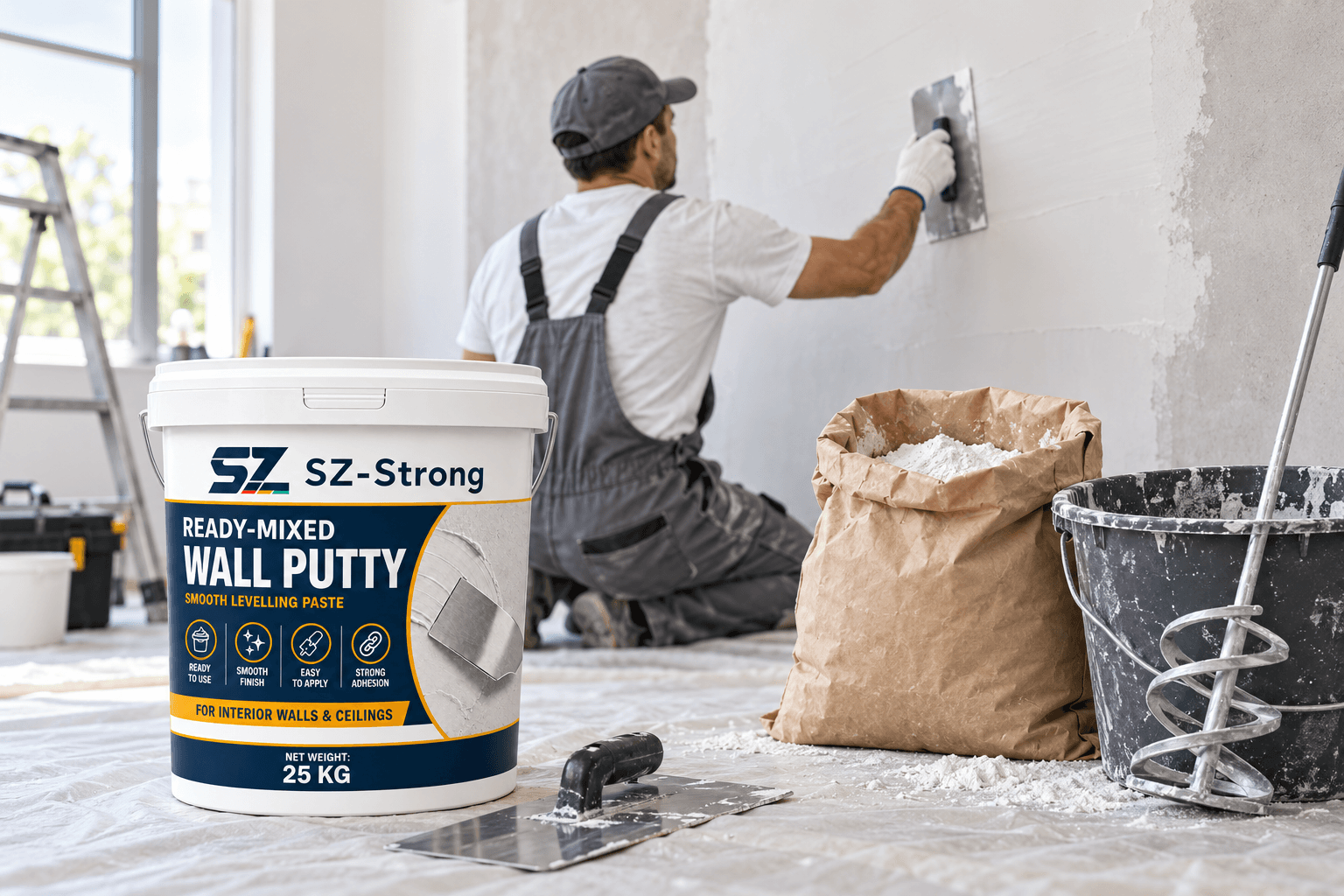
Ready-mixed wall putty and powder putty can both prepare a smoother base for paint, but they are not interchangeable purchasing formats. The supply form affects site mixing, consistency, packaging, transport, storage and the type of wall or exposure for which the product may be suitable. Distributors should compare the complete formulation and coating system rather than treating ready-mixed and powder products as the same material in different containers.
1. Start with formulation, not the words ready-mixed or powder
Ready-mixed describes a product delivered in usable paste form. Powder describes a dry product that requires a specified amount of clean water and controlled mixing before application. Neither term, by itself, confirms the binder, exposure rating, adhesion, filling ability or compatibility with the selected primer and topcoat.
A ready-mixed product may use an acrylic or other water-based binder, while powder products may be cement-based, gypsum-based or polymer modified. Ask the supplier to identify the exact chemistry and intended substrate. A useful quotation should state whether the grade is designed for interior plaster, concrete, masonry, gypsum board, renovation over sound coatings or another defined surface.
- Exact binder and product code
- Interior or exterior rating
- Approved substrates
- Maximum recommended layer thickness
- Compatible primer and topcoat
2. Ready-mixed wall putty reduces site-mixing variables
Ready-mixed wall putty arrives in a pail as a factory-prepared paste. Contractors avoid measuring water and mixing each batch from dry powder, which can help produce more consistent application when the product is stored, stirred and used according to its instructions. This is valuable in refurbishment, retail and project channels where convenience and a smooth interior finish are important.
The format does not remove the need for preparation. The wall must still be sound, clean and compatible, and any separation in the pail must be handled according to the product instructions. Adding uncontrolled water can change sag, coverage, drying and film properties. Buyers should confirm whether the product is ready to use after stirring or permits only a defined adjustment.
3. Powder putty shifts quality control to mixing and application
Powder wall putty is economical to transport because the shipment does not carry pre-added water, and sealed bags can be efficient for large construction channels. Its field performance, however, depends on clean water, accurate dosage, mixing equipment, resting or slaking time where required, working time and protection from contamination.
Two crews can obtain different consistency from the same bag if they use different water ratios or mixing methods. For distribution markets, the label and technical data sheet should present the mixing sequence in simple, locally understood language. Training samples should be evaluated with the same water quality and tools likely to be used by customers.
4. Compare the substrate and exposure before finish quality
A very smooth sample panel does not prove that a putty is suitable for every wall. Fresh cement plaster can be alkaline and may contain moisture. Old painted walls can carry dust, weak coatings or contamination. Gypsum board, concrete and masonry have different suction and movement. These conditions influence primer choice, adhesion, drying and the risk of cracking or delamination.
Interior and exterior requirements must be separated. A paste designed for dry interior rooms should not be sold for façades or persistent dampness without explicit supporting documentation. Wall putty is a surface-preparation layer; it should not be used to conceal active leakage, rising damp, unstable plaster or structural cracks. Those defects need diagnosis and repair before the decorative system is applied.
- Cement plaster, concrete, masonry or board
- New work or renovation
- Dry interior or weather exposure
- Moisture and alkalinity condition
- Cracks, movement and weak existing layers
5. Compare installed cost, not price per kilogram
Ready-mixed putty and powder putty cannot be compared fairly using container price alone. Ready-mixed material includes water and usually ships in rigid pails; powder ships in bags and is converted to a paste at the jobsite. Coverage depends on solids, density, surface roughness, layer thickness, waste and application technique.
Build a cost comparison using the same wall area and approved system. Include primer, number of coats, expected consumption, mixing labour, equipment, sanding, packaging disposal, site waste and touch-up material. For importers, add freight, pallet utilization and damage risk. The format with the lower material price may not produce the lower installed or landed cost.
6. Storage and shipping conditions change the commercial choice
Ready-mixed paste must be protected from unsuitable heat, freezing and long storage beyond the manufacturer’s stated conditions. Pail seals and lids need to withstand handling without leakage or skin formation. Powder must be protected from humidity and water ingress; damaged bags or poor warehouse conditions can create lumps and premature reaction.
Ask for stated shelf life, storage range and the minimum remaining shelf life at shipment. Review the actual route, including container exposure, port dwell time and distributor warehousing. Trial cartons, pails, bags and pallets under realistic handling conditions before approving a private-label pack.
7. Specify private-label packaging as part of the product
For ready-mixed wall putty, confirm pail size, net content, lid and tamper features, handle, label or in-mould decoration, batch coding and pallet arrangement. For powder putty, confirm bag construction, moisture barrier, valve or sealing method, print quality, net weight and stacking plan. Packaging minimums may differ from the formulation batch minimum.
Artwork should identify the approved substrate, preparation, application thickness, drying and recoating conditions, limitations, storage, safety information and traceability required for the destination. Avoid broad claims such as waterproof or crack proof unless the exact formulation and applicable evidence support the language.
8. Approve samples through a repeatable test panel
Prepare test panels using the intended substrate and full coating sequence. Record substrate condition, primer, mixing ratio for powder, application thickness, number of coats, drying conditions, sanding and final paint. Evaluate workability, sag, adhesion, shrinkage, cracking, sanding, surface appearance and compatibility with the proposed topcoat.
The evaluation sample, quotation, technical data sheet and commercial order should carry the same product code. Keep an approved reference sample and written acceptance record. When a distributor will sell into several climates or substrate traditions, repeat the trial for the important market combinations rather than extending one result to every country.
9. Send suppliers one wall-putty RFQ
A structured request makes quotations comparable. State the country, sales channel, substrate, interior or exterior exposure, current coating system, preferred supply format, pack size, annual estimate, label language and required documents. Ask the supplier to explain why the proposed grade fits the application and where it should not be used.
For many distributors, the right answer is not one format replacing the other. Ready-mixed paste can serve convenience-focused interior channels, while a suitable powder range can serve contractors accustomed to site mixing and high-volume bag supply. The portfolio decision should follow customer practice, technical fit and landed cost.
- Destination and customer channel
- Substrate and exposure
- Ready-mixed paste or defined powder chemistry
- Pack size, artwork and language
- Sample and full-system trial
- MOQ, lead time and shipment plan
Frequently asked questions
Is ready-mixed wall putty better than powder putty?
Neither format is universally better. Ready-mixed paste can reduce site-mixing variation and improve convenience for suitable applications. Powder can be efficient for transport and large projects but requires controlled water and mixing. Compare the exact binder, substrate, exposure, coating system and logistics.
Can ready-mixed wall putty be used on exterior walls?
Only when the exact product is explicitly designed and documented for exterior exposure. Many ready-mixed acrylic putties are positioned for dry interiors. Do not infer exterior suitability from the supply format or from a smooth sample panel.
What should distributors test before ordering wall putty?
Test the exact product on representative substrates using the proposed primer, application thickness and topcoat. Review workability, drying, sanding, adhesion, shrinkage, cracking, finish and package stability under expected market conditions.
Which format is cheaper to import?
Powder often transports efficiently because it does not include pre-added water, but the final comparison must include bags or pails, pallet utilization, damage, mixing labour, site waste, coverage and the complete installed system. Calculate landed and applied cost for the same wall area.
Can wall putty be supplied under a private label?
Private-label supply can be discussed for suitable products and quantities. Confirm the formulation, pack specification, artwork, claims, directions, batch coding, MOQ, approval sample and destination requirements before production.